
HÀ GIANG
A scrawny man wanders the courtyard of a crowded apartment block, calling out to buy old household items. His voice floats up and slips in among the neighbors shouting to one another from their open windows. Sewing machines hum behind doors, conversations drift out of rooms, and footsteps echo along the corridors. In one small flat, a shaft of sunlight through the window catches the dust hanging in the air. In the kitchen, soot-stained aluminum pots sit beside stacks of metal lunch containers. At night, grown-ups and children squeeze into the block leader’s cramped room, crowding around a tiny black-and-white TV and talking over whatever appears on the screen.
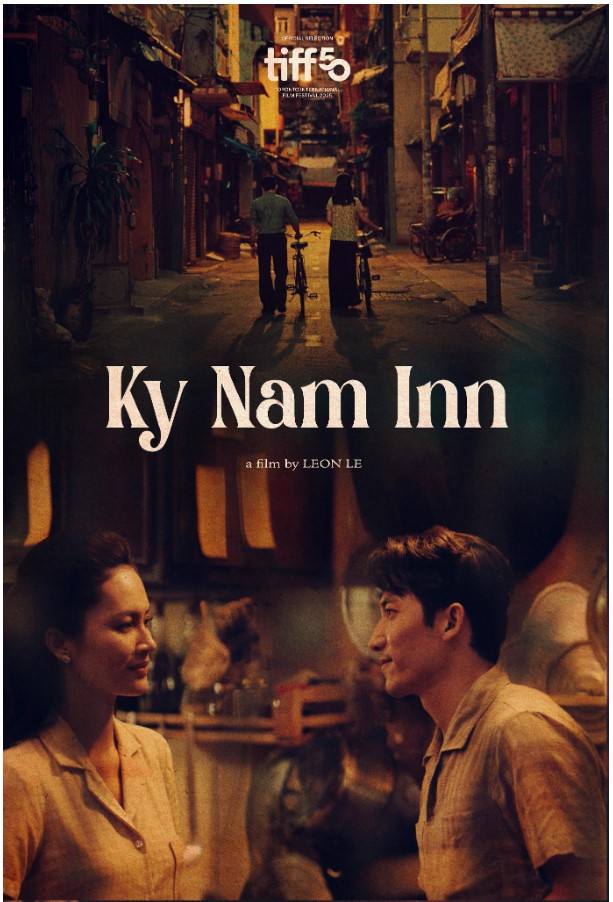
This is Saigon in 1985, as director Leon Le brings it to life in Ky Nam Inn (Quán Kỳ Nam), through the ordinary business of daily living. From the opening scenes and the first lines of dialogue, I was pulled into that world, the rooms, the conversations, the people going about their ordinary lives, with the odd feeling that I had been here before, that I had once lived among these people.
But how could I have? I left Vietnam at the end of April 1975, a full ten years before the story begins.
Ky Nam Inn was the closing-night film at Viet Film Fest 2026 in Southern California, and I went in with no particular expectations. I had loved Song Lang, Leon Le’s first feature, so I was looking forward to it, though a little wary of the 140-minute running time. I needn’t have worried. Once it started, I was riveted.
On the way out, I told my friend Trùng Dương, the writer, that it was my favorite film of the festival. She nodded and gave a vague “mm-hm,” which told me she didn’t quite agree.
For days afterward, the film kept coming back to me: the light in those rooms, the murmur of voices, faces passing through the courtyard. I had never seen any of it, and yet it all felt strangely familiar. It is rare for a film to stay with me that long.
One building, many lives
Leon Le brings the audience into this world through Khang (Liên Bỉnh Phát), a young man who has come down to Saigon from Đà Lạt. His uncle, who went North after the 1954 partition and is now a well-connected official in the Communist government, has found him a place to live in the building and a job at a publishing house. Khang’s assignment there is a new Vietnamese translation of Antoine de Saint-Exupéry’s The Little Prince, an important mission for the government at the time. As he gets to know his neighbors, what begins as one young man’s story becomes a portrait of an entire community, its residents drawn from different social backgrounds and carrying very different histories.
The neighbor who captures Khang’s attention is Ky Nam (Đỗ Thị Hải Yến). Once a French-educated woman of considerable social standing, she is now the widow of a general in the former South Vietnamese armed forces who was sent to a reeducation camp after 1975. She supports herself by cooking meals for the building and other local residents, who pay her by the month. All the while, she waits, with dwindling hope, for her son.
Every day she checks her mailbox, hoping for news of the son who vanished somewhere at sea. Her Amerasian nephew, Su, is also getting ready to leave Vietnam. Around them, families newly arrived from the North live side by side with Saigonese who stayed after 1975 when the war ended. Everyone carries a past, and everyone is trying to adjust to a radically changed society, where one’s family background and political history can determine everything from employment to future prospects.
Leon Le lets the residents’ stories come out little by little: over meals, during visits between neighbors, in whispered gossip, sometimes in sentences that break off and are never finished. One old man in the building likes to play tapes of pre-1975 Saigon music for everyone, and the songs are loved by all of them, regardless of which side they were on during the war.
Economic hardship, the police presence, endless bureaucratic rules, and upheaval of the 1985 currency reform all weigh on the residents. Even so, they joke with one another, scrape by, and lend one another a hand. Sometimes they also gossip and make life hard for each other. There are moments of real sorrow, and then, a beat later, an unexpected line has the whole theater laughing.
Within this small world, a quiet affection grows between Khang and Ky Nam, though both sense their relationship may be destined to end before it has truly begun. Khang is young, and his background and family connections to the new regime promise him a bright future. Ky Nam is the widow of a South Vietnamese general, carrying her losses and a wait that may never end. Years lie between them, but more so do their histories and the opposite sides they came from.
Viewers who follow only the love story may miss much of what Leon Lê is trying to tell. The relationship between Khang and Kỳ Nam is an important thread, but the film’s richness lies in the other lives unfolding around them.
What I loved most was the way Leon Lê makes room for the characters at the edges of that love story, letting each of them step forward with their own fears, hopes, habits, and ways of managing the circumstances life has dealt them. Together, they give us a more complete picture of what it meant to remain in Saigon after 1975.

Taking its time
Not every critic has been as taken with Ky Nam Inn as I was.
Rose Ho, writing in The Asian Cut, is full of praise, above all for the way Leon Lê conjures 1980s Saigon out of the daily life of a single apartment building. She draws a comparison with Wong Kar-wai’s In the Mood for Love, with one difference: Leon Lê widens a story about two lovers into a portrait of a whole community, where the North–South divide, fear of the authorities, and families split by war are all part of daily life. Ho is especially taken with Bob Nguyễn’s 35mm cinematography. In the Mood for Love, as she sees it, is a film of the night; Ky Nam Inn is its daylight twin, brighter and more hopeful.
Nirris Nagendrarajah, writing in Cha: An Asian Literary Journal, is more reserved. He, too, admires the images, Tôn Thất An’s score, and the film’s feel for political and social tension. But he finds it too long, and it loses steam as it goes, never quite escaping Khang’s point of view. We learn too little of what Kỳ Nam has lost and suffered, he argues, and so the film falls short of the emotional force its subject promises.
Stephen Aspeling, on his site Spling, admires the restraint of Liên Bỉnh Phát and Đỗ Thị Hải Yến, who let glances and gestures carry what goes unsaid. But he finds the film too still, the apartment block claustrophobic, and the whole thing at times closer to television than cinema. A tighter cut and a closer look at the political and social world around the characters could have given it more heft, he suggests.
I experienced the film’s unhurried pace quite differently.
The long stretches of everyday life never tested my patience. They were precisely what drew me in. I felt less like someone watching a story unfold than a visitor who had been allowed to spend time in the building. Every time the camera led me into another room, into another conversation, I came to understand a little more about the people who lived there.

Nor did I find the story stagnant. Its changes are simply understated.
At one point, Kỳ Nam tells Khang she has recovered from her injury and no longer needs his help. He should get back to his translation, she says. Khang refuses to leave. In an exchange that seems to be only about caregiving and work, we realize he has grown too attached to her to leave.
I can understand why some viewers want to know more about what goes on inside Kỳ Nam, but I never found she was an underdeveloped character. Early in the film, When Khang first moves in and asks to sign up for her meals, she turns him down flat, saying she is far too busy. Yet later, when Su brings home new orders, she takes them. The work was never the problem. Khang was: a young man with family ties to the new regime. Given everything she has lost, her caution makes sense. Leon Le trusts the audience to make these connections. Kỳ Nam’s history is revealed not through explanations of her feelings but through the choices she makes and the way she responds to others.
Saigon, rebuilt
Part of the film’s pull comes the extraordinary care Le and his collaborators have taken in recreating Saigon in 1985.
Cinematographer Bob Nguyễn shot the film on 35mm, and Ky Nam Inn’s interiors are especially beautiful. Soft light softly through windows onto worn walls, furniture, and household objects. These look like rooms people have lived in for years, not sets built for the camera.
There were compositions I wanted to linger over. Yet I never felt I was looking at a carefully arranged collection of vintage objects. The pots, tables, curtains, and television sets all belong to someone’s daily life. They have a purpose beyond announcing that the story takes place in 1985.
A friend who saw the film with me wondered about a few details: whether the police uniforms were the right color, for instance, or the bricks on certain buildings. Fair questions, especially for a film that works so hard to get 1985 Saigon right.
Having left Saigon in 1975, I’m in no position to judge. Still, a film can feel true without every object, color, and costume being exactly correct. Filmmakers have an obligation to respect the historical record, but they must also make the world they depict feel inhabited and alive.
That, for me, is where Ky Nam Inn succeeds most. Leon Le has done more than reconstruct an old apartment building. He has populated it with people whose joys, frustrations, anxieties, and small pleasures make their lives seem entirely real. History books can tell us what happened in a particular period. They rarely convey what it felt like to live through an ordinary day.
In the Q&A session after the screening, Leon Le spoke about his filmmaking as a way of returning to the Saigon of his childhood. Song Lang was where that journey began. With Ky Nam Inn, he said, he felt he had completed that journey through the Saigon of the 1980s and was ready to turn to other stories.

A journey home
One image from Ky Nam Inn stayed with me longer than the rest: Kỳ Nam opening her mailbox, day after day, and finding it empty.
For days I couldn’t work out why that scene wouldn’t let me go. Then I remembered the first letter I sent home after leaving Vietnam in 1975.
For more than a year after I left, I didn’t dare write home. I didn’t know whether my family had gotten out or stayed behind, and if they were still there, I was afraid a letter from a daughter who left the country might get them into trouble.
Then one day I was reading Văn Nghệ Tiền Phong, Nguyễn Thanh Hoàng’s weekly, which had started up again in the United States. In its “Missing persons” column was a notice from someone whose address was near my family’s old home in the Hồ Tắm Cộng Hòa area. I called the number, explained my situation, and asked whether a letter from overseas could put my family in danger.
The voice on the other end belonged to an elderly man, and he was kind. “Go ahead and write, don’t be afraid,” he said. “I’ve been writing to my own family, and it’s been fine.”
I took his advice, but still couldn’t shake my fear. On the envelope, I wrote a close friend’s name as the sender and my own name as the recipient, hoping that might spare my family any trouble.
It wasn’t until 1990, when I went back to Vietnam for the first time, that I learned what had happened the day that letter arrived.
My mother told me she was down in the kitchen when she heard my father shout, and she rushed out to see what was wrong. There he stood, arm raised high, waving the envelope like a trophy. The moment he saw her, he cried out:
“It’s from Hà! A letter from our Hà!”
He was so overwhelmed that it took him a while to calm down enough to open it. He had recognized my handwriting at once, even though the return address bore the name of a close friend of mine who was always at our house.
In the film, Ky Nam waits for word from a son who has gone silent. Back in Saigon, my own father had waited more than a year to hear from his daughter.
Perhaps that is why Ky Nam Inn has stayed with me. The Saigon of 1985 that Le recreates felt strangely familiar, yes. but the film also brought to the surface something I had never fully articulated: how much I wished I could have been there with my family during those years, sharing their daily lives instead of learning about them through letters and news from across the ocean.
For Leon Le, the film is a journey back to the Saigon of his childhood. For me, it was a journey back to the years my family lived through without me — years I had always wished I could have shared with them.
Other articles by Hà Giang: https://www.toiyeutiengnuoctoi.com/category/tac-gia/a-to-h/ha-giang/